
Let Sino-Australia Accounting help you register a company in Australia
Australian

Australia is a stable democratic country with a federal parliamentary constitutional monarchy and a population of over 24 million. The official language is English. Australia is a highly developed country. Its multiculturalism, pleasant weather, mature political system, no property tax, and emphasis on humanities and scientific research have made it the top country for immigration and investment for many years.
Basic Requirements for Establishing a Company in Australia
Choice of Company Types
| Types | Sole Trader | Partnership | Pty Ltd |
|---|---|---|---|
| Legal Liability | Personal Unlimited Liability | Joint Liability of Partners | Limited Liability of Shareholders |
| Registration Requirements | Only Need to Apply for an ABN | Partnership Agreement + ABN Required | ASIC Company Registration |
| Applicable Scenarios | Micro Business | Professional Services Industry | Medium to Large Business Entities |
Eligibility criteria for company registration in Australia
Directors and Shareholders
Applicants for registering a company in Australia must have a minimum number of directors and shareholders. This will depend on the requirements of the specific form of entity. A proprietary company must have at least one director who resides in Australia. Therefore, a foreign company or individual wishing to set up a company in Australia usually requires the services of a resident who is willing to take on the role of a nominee resident director. In view of the responsibilities and fiduciary risks of acting as a company director in Australia, the person should have experience in meeting corporate governance and other business registration requirements.
Age requirement
All directors, shareholders and key management personnel of an Australian company must be aged 18 or over. Written consent is required from the individual operating the company in Australia. FIRB approval
If a non-Australian person acquires shares, FIRB approval must be obtained under Australia’s foreign investment regime.
other
Free Trade Agreements Australia has free trade agreements with other countries that allow it to trade without interference. In addition, Australia has DTAAs with other countries. This does not tax investors twice. Australia's current corporate tax rate is 30%.
Stable business environment
Australia provides an ideal environment for conducting different forms of business activities. Such an environment is supported by a stable political system. The country has a low inflation rate. Therefore, investors can register their company in Australia.
Standard Establishment Process
1.Preliminary Preparation Stage
-
Name Pre-Approval:Conduct a name check through the ASIC website (prohibited restricted words such as 'Bank' / 'Trust')
-
Drafting of Articles:Adopt the standard articles under the Companies Act or customize them (subject to lawyer verification)
-
Verification of Director Qualifications:Non-Australian directors must provide notarized copies of their passports
2.Government Registration Stage
-
Submit ASIC Forms:
-
Form 201 (Company Registration Application)
-
Director and Shareholder Identity Declaration (Foreign documents require NAATI certified translations)
-
-
License Granted:
-
Australian Company Number (ACN)
-
Australian Business Number (ABN)
-
Goods and Services Tax (GST) Registration (Required if turnover ≥ AUD $75,000)
-
3. Obligations After Establishment
-
Annual Reporting:Submit annual financial statements to ASIC (small businesses may be exempt from audit)
-
Tax Registration:Report income tax to the ATO (standard tax rate 30%, with a reduced rate of 25% for annual revenue <$50 million)
-
Labor Compliance:Employees are required to contribute to superannuation (currently at a rate of 11%)
Special Considerations for Foreign Enterprises
1.Board of Directors' Responsibility System
-
Statutory ObligationsRequired to comply with Articles 180-184 of the Companies Act
✓Duty of Care and Diligence
✓ Conflict of Interest -
Penalties for Violations:Personal fines of up to AUD 1.26 million or 5 years imprisonment
2.Industry Regulatory Requirements
| Industry | Licenses and Permits | Regulatory Authority |
|---|---|---|
| Financial Services | AFSL License | ASIC |
| Food Sales | Food Business Registration | State Health Department |
| Construction Engineering | Builder Licence | State Agencies such as QBCC/VBA |
澳洲公司常見的四種商業主體形式
(1)Branch Office
定義:境外母公司在澳洲設立的非獨立法人機構,法律上隸屬於母公司,不具備獨立法人資格。
特點:
澳洲分支的債務、法律責任由母公司全額承擔,風險會傳導回總部。
稅務上通常被視為「非居民企業」,需就澳洲來源所得繳稅,利潤匯回母公司時可能涉及預提稅。
優點:設立流程相對簡單,無需重新發起新公司;缺點:母公司風險敞口大,信譽受澳洲分支經營影響。
適用場景:短期進入澳洲市場、開展試點業務,或母公司希望直接控制海外業務。
(2) Representative Office
定義:境外企業在澳洲設立的聯絡 / 展示型機構,僅限於市場調研、品牌推廣、客戶聯絡等非營利性活動,不能直接簽訂商業合同或從事經營。
特點:
無獨立法人資格,不產生營業收入,無需繳納企業所得稅。
設立門檻低,監管較寬鬆,但業務範圍嚴格受限。
適用場景:企業剛進入澳洲市場,用於前期市場考察、建立當地聯繫,不涉及實際商業交易。
(3) Public Company
定義:在澳洲證券交易所(ASX)掛牌上市的股份有限公司,股權公開發行並可自由交易。
特點:
具備獨立法人資格,股東以出資額為限承擔有限責任。
需嚴格遵守 ASX 上市規則,定期披露財務報告、股權變更等信息,監管要求極高。
融資渠道多元,可通過發行股票、債券等方式募集資金,提升品牌知名度。
適用場景:成熟大型企業,有強烈的融資需求、品牌擴張需求,且願意接受高度公開化監管。
(4)Private Company
定義:澳洲最主流的商業主體形式,是封閉型股份有限公司,股東人數限制在 50 人以內,股份不公開發行。
特點:
具備獨立法人資格,股東承擔有限責任,個人資產與公司風險隔離。
設立流程簡便、治理結構靈活,稅務處理清晰,是中小企業首選。
對外融資能力弱於上市公司,股權轉讓需符合公司法規定。
適用場景:絕大多數中小企業、創業公司、家族企業,以及跨境投資者進入澳洲市場的首選架構。
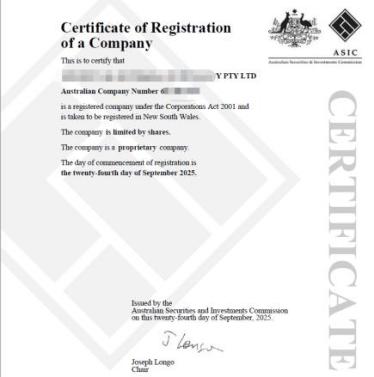
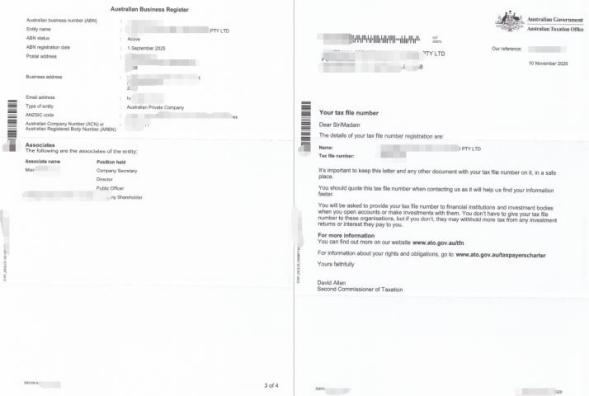
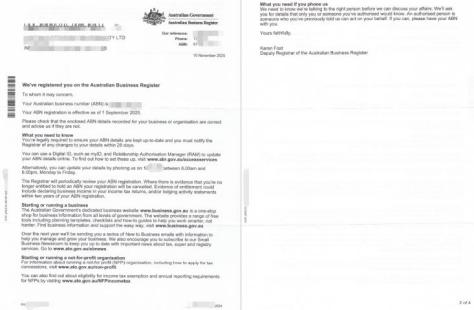
商業登記證書
Australian Taxation Overview
When operating a business in Australia, understanding the local tax system is an important step to ensure compliance with business regulations. Australia's tax system includes specific taxes such as corporate income tax, value-added tax, and personal income tax. The following is a detailed introduction to some key aspects of corporate taxation in Australia.
澳洲稅種
Corporate income tax (tax rate)
Standard tax rate: Australia's standard corporate income tax rate is 30%.
Small business tax rate: The small business tax rate for businesses with an annual turnover of less than AUD 50 million is 27.5%.
Tax obligations
Enterprises need to declare and pay corporate income tax every year, which is usually divided into advance payment and annual settlement. Advance payment will be adjusted at the annual settlement.
VAT (Consumption Tax) Rates
Standard rate: 10%
Tax obligations
Enterprises need to declare and pay VAT on a monthly or quarterly basis. VAT payment includes the deduction of output tax and input tax.
Withholding tax (tax rate)
Dividends, interest and royalties: 30%.
Service fee: None
Tax obligations
When paying the above income, the company must withhold and pay withholding tax.
Personal income tax (tax rate)
Progressive tax rates: ranging from 0% to 45%, depending on individual income level
Tax obligations
Companies are required to withhold personal income tax for their employees and submit monthly reports and payments.
Import tariffs
The tax rate ranges from 0% to 5% depending on the type of goods and their country of origin.
Special Consumption Tax
Applies to certain goods such as tobacco and alcohol, with tax rates ranging from 10% to 70%.
Tax incentives
Investment Incentives
The Australian government provides a variety of tax incentive policies to attract foreign investment and promote local investment, including but not limited to:
Tax exemptions: Newly established enterprises in certain industries such as high-tech, agriculture and environmental protection industries can enjoy corporate income tax exemptions for a certain period of time.
Tax Free Period
Enterprises investing in specific economic zones can enjoy corporate income tax exemption for a certain period of time.
Regional Specials
Enterprises investing in specific special economic zones or industrial promotion areas can enjoy additional tax incentives.
Periodic declaration
File different tax returns on a monthly, quarterly and annual basis.
Invoice Management
Ensure that invoices for all transactions are legal and compliant. Tax Audit: Regularly accept audits and inspections by tax authorities.
Easy landing in Australia: full-process service for business registration
Why choose Sino-Australia Accounting?

Our professional staff at Sino-Australia can provide you with the following services in one stop:
- Australian Company Formation Services
- Australia Resident Director Services
- Provide Australian registered and correspondence address
- ABN GST registration
- Tax Compliance Services
- Investment Immigration FIRB Application
- Australian company opening a bank account in Hong Kong
- Eligible business structures for companies registered in Australia