
Let Sino-Australia Accounting help you register a company in Australia
Australian

Australia is a stable democratic country with a federal parliamentary constitutional monarchy and a population of over 24 million. The official language is English. Australia is a highly developed country. Its multiculturalism, pleasant weather, mature political system, no property tax, and emphasis on humanities and scientific research have made it the top country for immigration and investment for many years.
Basic Requirements for Establishing a Company in Australia
Choice of Company Types
| Types | Sole Trader | Partnership | Pty Ltd |
|---|---|---|---|
| Legal Liability | Personal Unlimited Liability | Joint Liability of Partners | Limited Liability of Shareholders |
| Registration Requirements | Only Need to Apply for an ABN | Partnership Agreement + ABN Required | ASIC Company Registration |
| Applicable Scenarios | Micro Business | Professional Services Industry | Medium to Large Business Entities |
Eligibility criteria for company registration in Australia
Directors and Shareholders
Applicants for registering a company in Australia must have a minimum number of directors and shareholders. This will depend on the requirements of the specific form of entity. A proprietary company must have at least one director who resides in Australia. Therefore, a foreign company or individual wishing to set up a company in Australia usually requires the services of a resident who is willing to take on the role of a nominee resident director. In view of the responsibilities and fiduciary risks of acting as a company director in Australia, the person should have experience in meeting corporate governance and other business registration requirements.
Age requirement
All directors, shareholders and key managers of Australian companies must be over 18 years of age. Individuals operating a company in Australia must obtain written consent and obtain FIRB approval
If a non-Australian person acquires shares, FIRB approval must be obtained under Australia’s foreign investment regime.
other
Free Trade Agreements Australia has free trade agreements with other countries that allow it to trade without interference. In addition, Australia has DTAAs with other countries. This does not tax investors twice. Australia's current corporate tax rate is 30%.
Stable business environment
Australia provides an ideal environment for conducting different forms of business activities. Such an environment is supported by a stable political system. The country has a low inflation rate. Therefore, investors can register their company in Australia.
Standard Establishment Process
1.Preliminary Preparation Stage
-
Name Pre-Approval:Conduct a name check through the ASIC website (prohibited restricted words such as 'Bank' / 'Trust')
-
Drafting of Articles:Adopt the standard articles under the Companies Act or customize them (subject to lawyer verification)
-
Verification of Director Qualifications:Non-Australian directors must provide notarized copies of their passports
2.Government Registration Stage
-
Submit ASIC Forms:
-
Form 201 (Company Registration Application)
-
Director and Shareholder Identity Declaration (Foreign documents require NAATI certified translations)
-
-
License Granted:
-
Australian Company Number (ACN)
-
Australian Business Number (ABN)
-
Goods and Services Tax (GST) Registration (Required if turnover ≥ AUD $75,000)
-
3. Obligations After Establishment
-
Annual Reporting:Submit annual financial statements to ASIC (small businesses may be exempt from audit)
-
Tax Registration:Report income tax to the ATO (standard tax rate 30%, with a reduced rate of 25% for annual revenue <$50 million)
-
Labor Compliance:Employees are required to contribute to superannuation (currently at a rate of 11%)
Special Considerations for Foreign Enterprises
1.Board of Directors' Responsibility System
-
Statutory ObligationsRequired to comply with Articles 180-184 of the Companies Act
✓Duty of Care and Diligence
✓ Conflict of Interest -
Penalties for Violations:Personal fines of up to AUD 1.26 million or 5 years imprisonment
2.Industry Regulatory Requirements
| Industry | Licenses and Permits | Regulatory Authority |
|---|---|---|
| Financial Services | AFSL License | ASIC |
| Food Sales | Food Business Registration | State Health Department |
| Construction Engineering | Builder Licence | State Agencies such as QBCC/VBA |
Four common forms of business entities in Australian companies
(1)Branch Office
Definition: A non-independent legal entity established in Australia by an overseas parent company. It is legally subordinate to the parent company and does not have independent legal personality.
特點:
The debts and legal liabilities of the Australian branch are fully borne by the parent company, and the risks will be transmitted back to the headquarters.
For tax purposes, it is generally regarded as a "non-resident enterprise" and is subject to tax on Australian-source income. Withholding tax may be involved when profits are repatriated to the parent company.
Advantages: The establishment process is relatively simple and there is no need to re-launch a new company; Disadvantages: The parent company has high risk exposure and its reputation is affected by the operation of the Australian branch.
Applicable scenarios: short-term entry into the Australian market, pilot business, or the parent company wants to directly control overseas business.
(2) Representative Office
Definition: A liaison/exhibition agency established by overseas enterprises in Australia is limited to non-profit activities such as market research, brand promotion, and customer liaison, and cannot directly sign commercial contracts or engage in business operations.
Features:
It has no independent legal personality, does not generate business income, and does not need to pay corporate income tax.
The establishment threshold is low and supervision is loose, but the business scope is strictly limited.
Applicable scenarios: Enterprises have just entered the Australian market. They are used for preliminary market inspections and establishing local contacts, and do not involve actual commercial transactions.
(3) Public Company
Definition: A company limited by shares listed on the Australian Securities Exchange (ASX), with shares publicly issued and freely tradable.
Features:
It has independent legal personality and shareholders have limited liability limited to the amount of their capital contribution.
It is necessary to strictly abide by the ASX listing rules and regularly disclose financial reports, equity changes and other information. The regulatory requirements are extremely high.
Financing channels are diverse, and funds can be raised through the issuance of stocks, bonds, etc. to enhance brand awareness.
Applicable scenarios: Mature large enterprises with strong financing needs and brand expansion needs, and are willing to accept highly open supervision.
(4)Private Company
Definition: The most mainstream form of business entity in Australia is a closed joint-stock company, with the number of shareholders limited to 50 and shares not publicly issued.
Features:
It has independent legal personality, shareholders bear limited liability, and personal assets are isolated from company risks.
The establishment process is simple, the governance structure is flexible, and the tax treatment is clear, making it the first choice for small and medium-sized enterprises.
Their external financing capabilities are weaker than those of listed companies, and equity transfers must comply with company law regulations.
Applicable scenarios: The preferred structure for most small and medium-sized enterprises, startups, family businesses, and cross-border investors to enter the Australian market.
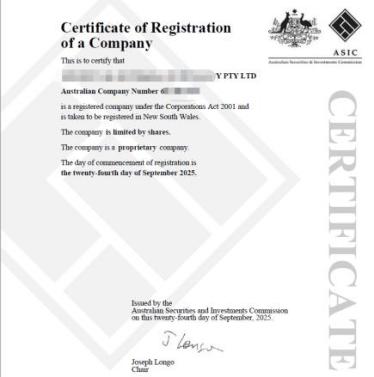
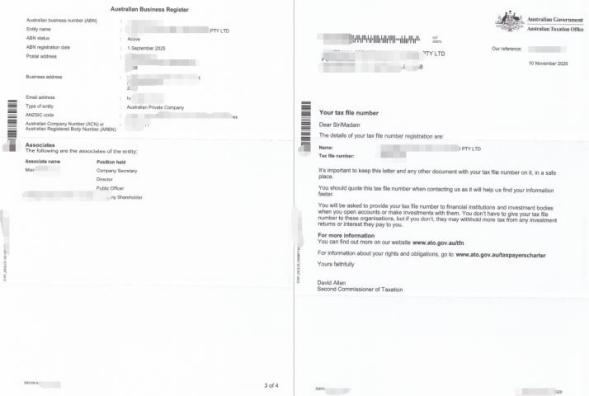
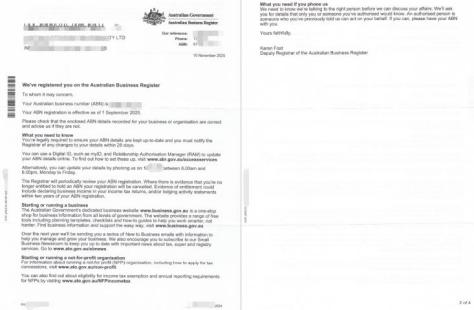
business registration certificate
Australian Taxation Overview
When operating a business in Australia, understanding the local tax system is an important step to ensure compliance with business regulations. Australia's tax system includes specific taxes such as corporate income tax, value-added tax, and personal income tax. The following is a detailed introduction to some key aspects of corporate taxation in Australia.
Australian taxes
Corporate income tax (tax rate)
Standard tax rate: Australia's standard corporate income tax rate is 30%.
Small business tax rate: The small business tax rate for businesses with an annual turnover of less than AUD 50 million is 27.5%.
Tax obligations
Enterprises need to declare and pay corporate income tax every year, which is usually divided into advance payment and annual settlement. Advance payment will be adjusted at the annual settlement.
VAT (Consumption Tax) Rates
Standard rate: 10%
Tax obligations
Enterprises need to declare and pay VAT on a monthly or quarterly basis. VAT payment includes the deduction of output tax and input tax.
Withholding tax (tax rate)
Dividends, interest and royalties: 30%.
Service fee: None
Tax obligations
When paying the above income, the company must withhold and pay withholding tax.
Personal income tax (tax rate)
Progressive tax rates: ranging from 0% to 45%, depending on individual income level
Tax obligations
Companies are required to withhold personal income tax for their employees and submit monthly reports and payments.
Import tariffs
The tax rate ranges from 0% to 5% depending on the type of goods and their country of origin.
Special Consumption Tax
Applies to certain goods such as tobacco and alcohol, with tax rates ranging from 10% to 70%.
Tax incentives
Investment Incentives
The Australian government provides a variety of tax incentive policies to attract foreign investment and promote local investment, including but not limited to:
Tax exemptions: Newly established enterprises in certain industries such as high-tech, agriculture and environmental protection industries can enjoy corporate income tax exemptions for a certain period of time.
Tax Free Period
Enterprises investing in specific economic zones can enjoy corporate income tax exemption for a certain period of time.
Regional Specials
Enterprises investing in specific special economic zones or industrial promotion areas can enjoy additional tax incentives.
Periodic declaration
File different tax returns on a monthly, quarterly and annual basis.
Invoice Management
Ensure that invoices for all transactions are legal and compliant. Tax Audit: Regularly accept audits and inspections by tax authorities.
Easy landing in Australia: full-process service for business registration
Why choose Sino-Australia Accounting?

Our professional staff at Sino-Australia can provide you with the following services in one stop:
- Australian Company Formation Services
- Australia Resident Director Services
- Provide Australian registered and correspondence address
- ABN GST registration
- Tax Compliance Services
- Investment Immigration FIRB Application
- Australian company opening a bank account in Hong Kong
- Eligible business structures for companies registered in Australia